
When most people research a new mattress, one number tends to dominate: the spring count. More springs, the thinking goes, must mean better quality. Some mattresses now claim 30,000 springs. Others 40,000.
The most expensive bed in the world has 1,200.
This article explains what springs actually do, why spring count has become a marketing tool rather than a quality indicator, and what a well-informed buyer should focus on instead.
What Does a Pocket Spring Actually Do Inside a Mattress?
Quick Answer: The pocket spring was invented in 1901 to stop movement on one side of a bed reaching the other. It did that by giving each spring its own independent action. That single principle still defines quality today.
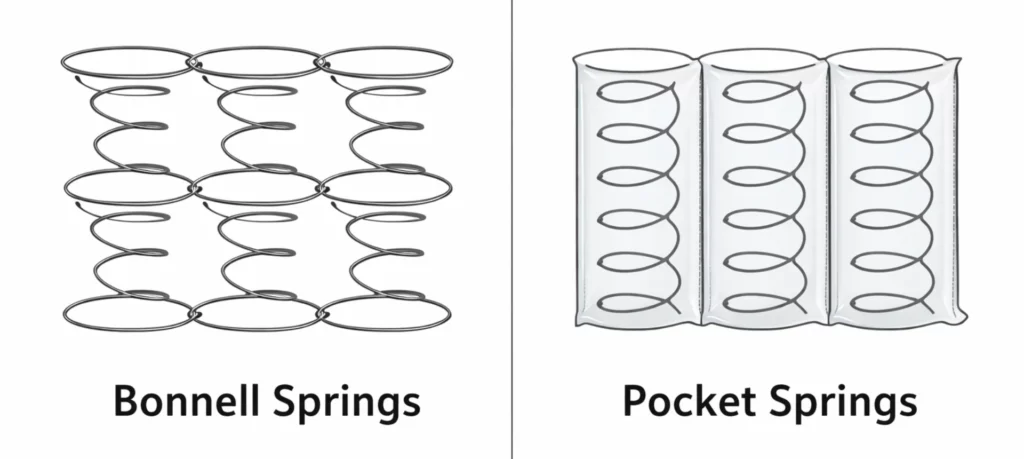
Before the pocket spring, most mattresses used a Bonnell or open coil unit: springs clipped together at the top, forming a single linked sheet. When one spring moves, they all move.
“I remember lying on a bed when I first got married. We had this brand new bed and every time I moved, it was like being on the sea. It really did get that movement. The pocket spring was a major, major development.”
— Brent Cooper, Founder of Marshall & Stewart
The solution came from a company that would name itself after the invention. They took a six-spiral spring and placed it inside a small calico pocket. Instead of clipping the springs together at the top, they joined each one through its centre. Each spring could now compress independently, without affecting its neighbours.
The Roman numeral for six is VI. The six-spiral spring in its pocket gave the company its name: Vispring. They have been making pocket spring beds in Devon ever since.
’
Brent’s Insight: Individual suspension is still the most important thing a spring system does. When your partner moves, their side responds. Yours barely notices. That is what the pocket spring gave us, and nothing since has improved on the principle.
Why Does a Higher Mattress Spring Count Not Always Mean Better Quality?
Quick Answer: Spring count is easy to understand and easy to compare. That makes it a useful selling tool in a showroom. It does not make it a reliable guide to how well the mattress will actually perform.
It is a question mainstream guides are now starting to address, GQ’s mattress buying guide touches on spring count as part of its overview. But most general guides stop at ‘more is not always better’ without explaining why. That is what this article is for.
The shift from Bonnell units to pocket springs created a new challenge for retailers: how do you explain the difference between two mattresses that look identical from the outside?
Spring count was the answer. It is simple, quantifiable, and creates an obvious hierarchy. One thousand springs sounds better than eight hundred. Two thousand sounds better than one thousand.
“The easiest thing in the world to sell, if you don’t know much about beds, is spring count. I’ve got a mattress here with a thousand springs. This one has twelve hundred. This one has fifteen hundred. People automatically assume the one with more springs costs more and must be better. The difference between a 1,000 and a 1,500 spring unit at cost is probably less than £100. In retail terms, it can be several thousand.”
— Brent Cooper
The numbers have since escalated well beyond anything that reflects genuine improvement. The result is an arms race of spring counts that tells buyers very little about how a mattress will actually perform.
Brent’s Insight: A well-made bed with 1,200 honest pocket springs will outperform a cheaply made bed with 2,500 springs every time. The spring count is a starting point, not a conclusion.
How Many Springs Is Enough in a Mattress? What the Evidence Says
Quick Answer: Anywhere between 1,200 and 3,000 quality pocket springs is the right range for a seriously made mattress. The most expensive production bed in the world has 1,200. That single fact is the clearest answer to the question.
The Vividus costs well over £200,000. Its makers have had no shortage of budget or expertise. They arrived at 1,200 springs not because they could not fit more in, but because 1,200, engineered correctly, is sufficient.
What they focused on instead was the spring itself. Rather than adding more springs, they extended the coil from six spirals to ten. A longer spring travels further before it meets resistance.
“A longer spring doesn’t have to be quite as firm to take your weight, because there’s more distance for it to travel. A lighter person uses the top of the spring. A heavier person travels further through it. Both are properly supported by the same spring.”
— Brent Cooper
When Marshall & Stewart first developed their range, Brent worked with springs up to 14 spirals. The principle is the same: depth of travel and quality of engineering matter far more than the number of springs on a specification sheet.
How Do Mattress Spring Counts Change With Bed Size?
Quick Answer: Spring counts in marketing materials are almost always based on a standard five-foot king-size bed. A super king will have more springs simply because it is wider. A double will have fewer. The advertised number is a benchmark, not a fixed total.
This confuses many buyers when comparing specifications across brands, and it is worth understanding before reading any mattress spec sheet.
“Spring counts are always calculated on a five-foot king-size bed. On a five-foot bed, a 1,500-spring unit is about the maximum you can physically fit in a single layer. As you go wider to a super king, you will have more springs. As you go narrower to a double, you will have fewer. The number you see advertised is the king-size figure.”
— Brent Cooper
This explains why some manufacturers list identical spring counts across all sizes, which is inaccurate. A genuine pocket spring mattress will have proportionally more or fewer springs depending on the size. If a brand claims the same count for a single and a super king, the number is being used as a model name rather than an actual specification.
Brent’s Insight: When comparing spring counts between brands, check whether the figure is for a king-size or another size. And if a brand lists the same number across all sizes, treat it as a marketing label rather than a real measurement.
When Do Extra Springs in a Mattress Actually Help? The Double Deck System
Quick Answer: There is one scenario where adding more springs genuinely improves a mattress: the double deck system, where two spring layers work together, one taking the body’s contour and one taking its weight.
In 1998, Vispring introduced a mattress using what has become known as the double deck unit: two layers of pocket springs, one on top of the other, in combination.
“The top spring takes the contour of the body. The bottom layer takes the support, the weight. Top layer comfort, bottom layer weight. That’s a legitimate engineering development.”
— Brent Cooper
This is the system used in the Marshall & Stewart Florentine and Cullinan mattresses. The Florentine combines two 1,200-spring units for around 2,500 in total. The Cullinan uses two 1,500-unit layers to reach 3,000. The Sancy and Hortensia, at the softer end of the range, use a single 1,500-spring unit, which is close to the physical maximum for a single layer in a standard five-foot king-size bed.
Brent’s Insight: Three layers of springs is where it goes wrong. You are back to something that feels like a Bonnell unit, too much movement, not enough solidity. Two layers, done well, is the sweet spot. Less is more.
What Are Mini Springs, and Why Do Some Mattresses Claim 30,000 Springs?
Quick Answer: Mini springs are tiny coils pressed into sheets and inserted into a mattress in place of natural fillings. They are why some mattresses claim 30,000 springs. They are also why those claims deserve considerable scepticism.
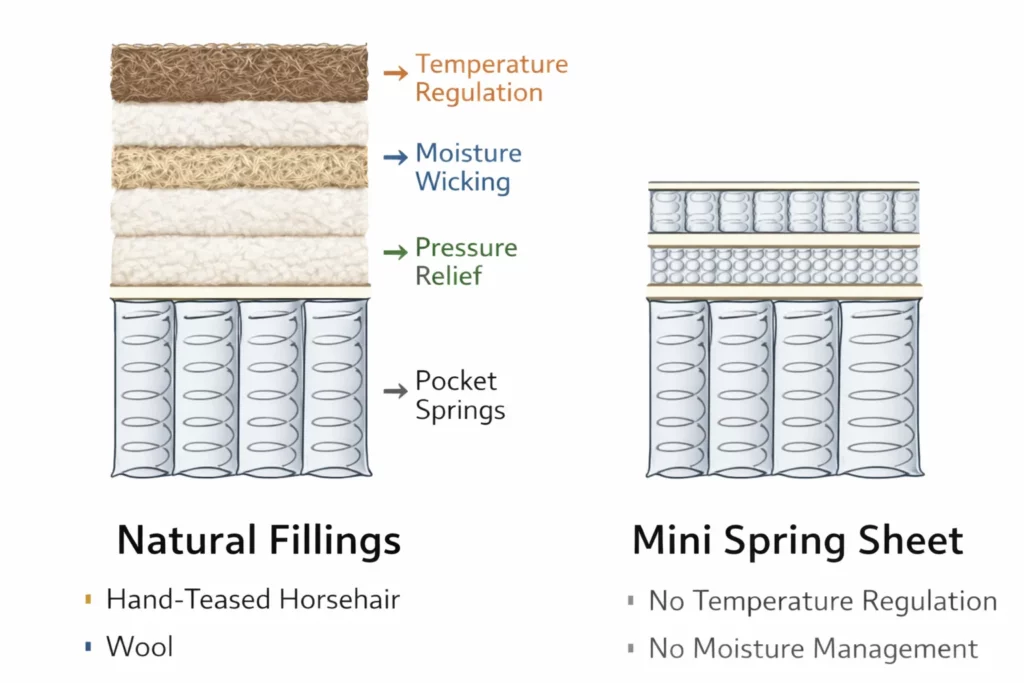
Harrison Spinks, a Yorkshire-based spring and mattress manufacturer, invented the mini spring and patented it widely. A single sheet of mini springs can contain 2,000 or more tiny coils. Stack two or three sheets inside a mattress alongside a conventional spring core and the total count climbs rapidly. Some mattresses reach 35,000 or 40,000 in this way.
“The core of the mattress is still maybe a 1,200 or 1,500 spring unit. But above and below it, they’ve added sheets of mini springs. They’re not telling any lies, because you have got 30,000 springs. But they’ve taken out quite a lot of the natural filling and replaced it with springs. It’s a different feel, and not in the way most people would hope.”
— Brent Cooper
The specific problem is physical. A conventional pocket spring is five to six inches long and has significant depth of travel. A mini spring has a diameter of roughly seven centimetres and almost no travel at all.
“Put any real weight on a mini spring and it’s flat. It has essentially compressed to nothing. There’s no depth of travel, no genuine suspension. It’s a marketing number, not an engineering improvement.”
— Brent Cooper
There is a further consequence rarely discussed. Natural fillings, horsehair, wool, cotton, regulate temperature and wick moisture throughout the night. Mini springs do neither. When they replace natural fillings, the mattress loses those properties entirely.
“Mini springs don’t regulate temperature. They don’t wick away moisture. They’re just extra springs. And in place of what? Horsehair and wool that were genuinely working for you.”
— Brent Cooper
Does a Higher Spring Count Mean a More Durable Mattress?
Quick Answer: No. Mattress durability is determined by the quality of the spring wire, how well the fillings are made and secured, and whether the mattress and base are designed to work together. Spring count is not a reliable predictor of how long a mattress will last.
This is one of the most common questions behind the spring count debate. The logic is understandable: more springs, more support, less sagging. In practice, the relationship is far more complicated.
A mattress sags when the fillings compact unevenly, when the spring wire loses its tension, or when the mattress is placed on a base that is already compromised. None of these are caused or prevented by having more springs.
“Springs are tested to British Standards. They simulate maybe 50 years of use on a single spring and you might lose two or three millimetres of height over that time. Springs don’t really fail. What changes is the fillings above them, and those are not covered by any guarantee. So a 25-year guarantee on a mattress is a 25-year guarantee on the spring. Stop worrying about that. Think about what’s above it.”
— Brent Cooper
The fillings in a mattress will compact over time regardless of how many springs are underneath them. That is normal and expected behaviour, not a fault. A well-made natural filling mattress will compact gently and evenly, moulding to the sleeper. A poorly made one will dip and sag unevenly.
Brent’s Insight: If you want a mattress that lasts, focus on the quality of the fillings and whether the base is sprung. A 1,500-spring mattress on a proper sprung base, rotated regularly and protected with a topper, will outlast a 5,000-spring mattress on a slatted frame every time.
What Does a Mattress Spring Guarantee Actually Cover?
Quick Answer: A mattress guarantee, whether 10, 15, or 25 years, is a guarantee on the springs. The fillings, the part of the mattress you sleep on, are specifically excluded.
Springs are remarkably resilient. Testing simulates decades of use and finds that most springs lose just two or three millimetres of height over their lifetime. That is why manufacturers can confidently offer 25-year spring guarantees. Springs rarely fail.
Natural fillings will compact and settle over time. This is expected and normal. It is not covered by a guarantee.
Brent’s Insight: When we guarantee the spring for 25 years, what we are saying is: stop worrying about the spring. Turn your attention to how the bed feels, how your body responds to it, and what the fillings are doing for your sleep. That is where the real quality lives.
What Should I Look For When Buying a Mattress Instead of Spring Count??
Quick Answer: Anywhere between 1,200 and 3,000 quality pocket springs is a solid foundation. Within that range, the count matters far less than the fillings, the base spring system, and how the bed actually feels to your body.
Confirm the spring count is in that range and ask whether any of the count comes from mini spring sheets. A good retailer will answer clearly. After that, put the spring count down.
“We tell people: we have sufficient springs to guarantee this mattress. Stop thinking about that and start thinking about how the mattress feels. How is your body reacting? Are there any pressure points? If you don’t feel the bed beneath you, if you just feel held, you’re probably in the right place.”
— Brent Cooper
Ask about the fillings instead. What are they, and why were they chosen? Ask how the base spring works with the mattress spring. Ask whether a topper is included or recommended.
Brent’s analogy: catching a cricket ball with a stiff arm sends it bouncing back. Cushion the catch and the ball stays in your hands. The mattress spring and base spring working together create that cushioning. A high-count mattress on a hard slatted base delivers none of it.
Brent’s Insight: The spring count debate distracts people from the real question: what is this bed actually going to do for my sleep? A 1,200-spring mattress with exceptional natural fillings on a sprung base, with a proper topper, will deliver better sleep than a 30,000-spring mattress that has traded its fillings for a marketing headline.
Come and Feel the Difference
The best way to understand what a spring system is doing is to feel it. Brent is available for personal consultations at the West End Bed Company in East Sheen, London, where every Marshall & Stewart model can be tried in person.
No pressure. No obligation. Just a conversation about your sleep.
Marshall & Stewart beds are handmade in England and available exclusively at the West End Bed Company, Upper Richmond Road, East Sheen, London SW14
Frequently Asked Questions About Mattress Spring Count
Is 1,000 springs enough in a mattress?
Yes, in most cases. A quality 1,000-spring pocket spring unit provides sufficient independent suspension for two people. The more important factors are the quality of the spring wire, the depth of travel, and the fillings above the spring. A 1,000-spring mattress built with proper natural fillings on a sprung base will outperform a poorly made mattress with twice the springs.
Why do some mattresses have 10,000 or 20,000 springs?
High spring counts above around 3,000 are almost always achieved by adding layers of mini springs: tiny coils pressed into flat sheets and inserted into the mattress in place of natural fillings. They inflate the headline number without improving support or comfort. Because mini springs have almost no depth of travel, they compress flat under any real weight and contribute little to the sleeping experience. What they replace, horsehair, wool, cotton, actually was working for you.
Does the spring count change if I buy a bigger mattress?
Yes. Spring counts quoted in marketing materials are based on a standard five-foot king-size bed. A super king will have proportionally more springs; a double will have fewer. If a brand lists the same spring count across all sizes, that figure is being used as a model name rather than a genuine measurement.
Is spring count related to how firm a mattress feels?
Spring count and firmness are separate things. Firmness is determined by the gauge of the spring wire: a thicker wire produces a firmer spring, a thinner wire a softer one. Two mattresses with identical spring counts can feel completely different depending on the wire gauge and the depth of the filling layers above the springs. This is why testing a mattress in person matters far more than reading a specification.
Do more springs mean the mattress will last longer?
No. Longevity depends on the quality of the spring wire, how the fillings are constructed and secured, and whether the mattress is used on a properly sprung base. Mattress guarantees cover the springs, not the fillings. The fillings will compact over time regardless of how many springs are underneath them. A well-made mattress with 1,500 honest springs will outlast a poorly made one with 5,000 every time.
A spring count is easy to print. Feel is not.
Everything above explains why the number on the label tells you less than the shop assistant quoting it thinks. The only way to settle it is to lie on beds with genuinely different spring configurations, one after another, in the same hour.
Westend Bed Company
215 Upper Richmond Road West, East Sheen, London SW14 8QT
020 7723 2925
A sleep consultation is free, takes about an hour, and there is no purchase expected. The team has over 180 years of combined experience between them.
The Cullinan is the deepest-support bed we make and the one to start on if spring count brought you here. See all six beds in the Diamond Collection or book a Sleep Consultation.
Related reading: The Hard Mattress Myth: Is Firmer Really Better?.